Most of this gets
switched off in a month.
Gartner expects more than four in ten agentic AI projects to be cancelled by the end of 2027, and the majority of pilots never reach daily use at all. The reason is almost never the model. It is that somebody bought a general purpose assistant and then went looking for a job to give it. This work starts at the other end: the two or three places your business actually loses money in a normal week, which for most local businesses is a phone nobody could get to and an enquiry nobody followed up, and it puts something narrow and boring in each one. That starts with the call nobody could answer, and it carries on into the quote, the invoice and the paperwork that eat your Sunday. If you sell appointments rather than jobs, it is the no show, the gap a cancellation left, and the customer who was due back in March. You watch it run on your own business before the monthly fee starts.
It answers in your browser, in about thirty seconds, without you giving anybody a phone number. Try getting it to quote you a price.
This is a separate line of work from the marketing. We also build websites and run search, ads and email, and none of that is attached to any of this. You can buy either without the other, and we would rather tell you which one your money is better spent on first than sell you both. The marketing side is here.
A real call, answered and written up while you sleep.
A live run of our demo: it took the job, the caller's name, suburb and number, and the text back went out on its own. The same assistant we install on a real line.
Try it yourself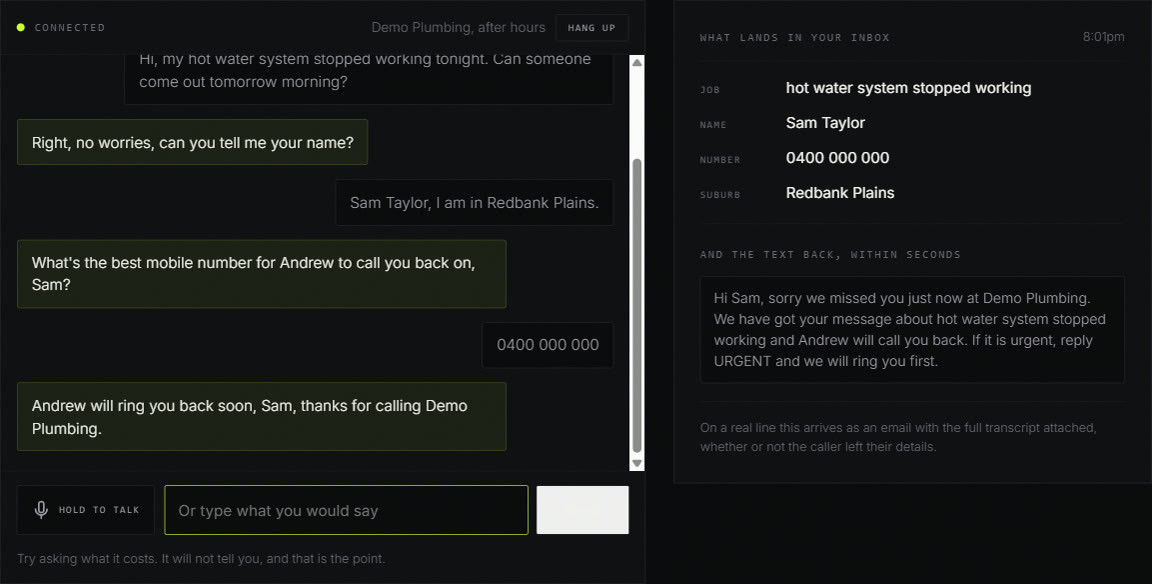
AI opportunity audit
$250 once, not a retainer. Before anything is built we count the leaks, using your numbers rather than an industry average. Nothing is installed, nothing is changed, and you keep the findings whether or not you do anything else with us.
- Where enquiries actually arrive, and what happens to each one. Calls, forms, email, Google Business messages, socials. Most owners are surprised by at least one of the five.
- How many calls go unanswered, read from your own phone records. Not from a statistic about your trade. It is usually the largest single line in the audit.
- How long an enquiry waits for its first reply, measured across a month of your own inbox rather than from what it feels like.
- What is worth automating, what is worth a person simply doing sooner, and what is worth nothing. The third category is real and we will name it.
- A costed list, cheapest first, with what we would charge to build each item and what it would cost you to run every month, kept separate.
Most audits end with one or two items on that list, not seven. If the honest finding is that not enough people are ringing you in the first place, we will say so and point you at search or ads instead, even though the automation is the larger invoice. The $250 is credited in full against any AI build you start within 30 days.
Missed call text back
$450 to build, then $110/mo.
The least we charge for anything on this page.
This one does not answer your phone and does not pretend to. It notices the call you did not take and texts that person back within a few seconds, while they are still holding the phone and deciding who to ring next. A caller who gets a text in ten seconds usually stops dialling. A caller who gets voicemail rings the next name on the list.
- Your own mobile stays the number on the van. We set your phone to divert calls you do not answer to a number we run. Nothing changes about your ads, your signage or how you work, and you can switch it off yourself from the keypad in about four seconds.
- The text names your business, says you are on a job, and carries your booking link. It is sent from a real mobile number rather than a brand name, so the person can simply write back, and their reply comes to your phone.
- A different message outside your hours, so nobody is told you will call them back this afternoon at nine at night.
- One caller, one text. Somebody anxious who rings three times in a row is one job, not three, and three identical texts reads as a fault.
- STOP is honoured permanently, on our side, on every system we run, and the instruction is in every message.
- A monthly count of what happened: calls missed, texts sent, and the ones we deliberately did not send, each with the reason. That last column is the honest one and most reports do not have it.
What it will not do, before you ask. It cannot text a landline, and a real share of calls to a trade come from one. A text to a landline is billed and then silently discarded, so we do not send it, and your report tells you how many there were rather than quietly counting them as contacted. It does not know whether you rang the person back either. The promise in that message is yours to keep, which is exactly why you choose its wording and we do not choose it for you.
If you want the call actually answered and the job written down, that is phone answering, and this is not a cheaper version of it. This is the one to start with when you are not sure the problem is real: it is the smallest thing that will show you, on your own numbers, how many people were ringing and giving up.
After hours, overflow and missed calls
$1,200 to build, then $290/mo.
First 300 answered minutes each month included.
A tradesperson under a house cannot answer the phone, and a caller who reaches voicemail rings the next name on the list rather than leaving a message. This is the one piece of AI where the value is not really in dispute, because the size of the problem is already sitting on your own call log.
- It answers on the numbers you choose, at the hours you choose. You can start with after hours and overflow only, so nothing at all changes about how the phone works while you are at your desk.
- It takes the name, the number, the suburb and what the job is, and it can book straight into your calendar or simply capture and send, whichever you actually trust.
- Every call transcribed into your inbox within a minute of it ending, including the ones where the caller hung up. A hang up at 7pm is still somebody who wanted something.
- A missed call gets a text back within seconds. If answering is the best outcome, answering by text before they dial the next number is the second best, and it is the cheapest thing on this page.
- Genuinely urgent work is passed to a real human number instead of being handled. You write the definition of urgent, not us.
- It says it is an assistant, and that the call is recorded, at the start of every call. Several Australian states require every party to a conversation to be told, so we disclose on all of them rather than keeping a map of which state a caller is standing in.
You do not have to take our word for any of that. Talk to it here and try to get a price out of it. It runs in your browser rather than on a phone line, because a live line needs an account with a card attached and that is yours to open, not ours. The conversation logic is the same one we install.
What the phone system is not
It is not a receptionist and it will not pretend to be one. It takes a message properly and it books a straightforward job. It cannot calm down an angry customer, and it will not try.
We do not do outbound AI calling, at any price. That is not a gap in what we can build. The Do Not Call Register and the ACMA rules apply to a machine exactly as they apply to a person, there is no carve out for AI, and there is no version of a robot ringing strangers that we want your business name attached to.
Voice costs money by the minute and we would rather be plain about it. The 300 included minutes are roughly one hundred short calls. Past that it is $0.45 a minute, which is about double what the call costs us to carry. We would rather tell you the margin is there than dress the overage up as a pass through.
It will get things wrong. What it is built not to do is invent an answer about your prices, your availability or whether you cover a suburb. On anything it has not been given, it says a person will confirm, and then a person does.
Enquiry follow up and quote chasing
$900 to build, then $240/mo.
The second largest leak in most small businesses is not the enquiry that never came. It is the one that arrived on a Thursday, was read on a phone in a car park, and was never replied to. Speed of first reply decides more of these than price does.
- Every enquiry from every channel lands in one place, timestamped, so nothing sits in a second inbox that gets checked weekly.
- A reply drafted within minutes, in your words, waiting for you to press send. It does not send by itself unless and until you decide it should.
- The qualifying questions asked while they are still interested: suburb, timeframe, rough budget, what they have already tried. That is the difference between a name and a job.
- Quotes that go quiet get chased on a schedule you set, and the chasing stops the moment they reply or ask it to.
- A weekly list of what came in, what was answered and what is still waiting on you. Usually the most uncomfortable page we send, and the most useful.
Answers on your own site
$1,400 to build, then $180/mo.
Most website chatbots are quietly removed within a year of going up, and the reason is nearly always one of two things: it answered confidently and it was wrong, or it stood between a customer and a human being. Both are decisions made at build time, and both can be decided the other way.
- Trained on your material and nothing else. Your pages, your price list, your terms, your service areas, your policies. It does not go and read the internet about your industry.
- When it does not know, it says so. That single behaviour is most of the difference between a useful assistant and the reason somebody leaves your site annoyed.
- It hands over rather than holding on. A request for a person produces a person, not three more questions.
- Every conversation logged and readable. That log is often worth more than the assistant is, because it is a list, in your customers' own words, of the questions your website should have answered on the page.
- Those questions then get written into the site properly, which is the part almost nobody does.
Reviews, asked for once and replied to properly
$600 to build, then $160/mo.
For a local business the review profile does more selling than the website does, and it is the thing most owners intend to get around to. This makes the asking automatic and the replying quick, and it does neither of them in a way that would embarrass you.
- The ask goes out at the right moment, by text or email, to the customer you nominate, once. Not three times, and not to everybody on the list at once.
- A reply drafted for every review, good and bad, for you to approve. A bad review answered calmly and specifically sells to the next reader better than a five star one does.
- Never incentivised, never filtered, never gated. Screening people so that only the happy ones reach the review form breaches Google's own policy and sits squarely in what the ACCC treats as misleading. We will not build it, and we will talk you out of it.
- A monthly count of asks sent, reviews received and replies published, so you can see whether it is working rather than assume it is.
Whether AI assistants name you at all
$420/mo, or $250/mo alongside a Found retainer.
No setup fee.
A growing share of buyers now ask an assistant who the good ones are, and ring two of the three names it gives back. That is a different question from where you rank, it is answered by a different machine, and at the moment almost nobody is checking it. It is also the least proven service on this page, and it is priced accordingly.
- We measure whether you are named, across the assistants people actually use, for the questions your buyers actually ask, and we track it month to month.
- Then we fix what is fixable: pages that answer the question directly, the structured data, and the facts about your business that currently disagree with each other across the web.
- The third party sources these systems lean on get attention, because they lean on other people's descriptions of you far more heavily than on your own site.
- Reported as a count, not a rank. Named in four of twelve questions this month, six last month, and what changed in between.
Honestly: nobody can guarantee a citation, these systems change from week to week, and if your business has almost no independent mentions anywhere then this will do very little until that changes. If that is you, we will say so and sell you the cheaper thing.
One automation at a time
From $1,200 per workflow, then $190/mo.
Covers up to three, then $60/mo each.
Every business has one job somebody hates doing on a Friday afternoon. Those are worth automating one at a time and priced per workflow, so you are never subscribing to a platform in order to solve a single problem.
- Photos and notes from a job turned into the written report that has to go to the client or the certifier.
- Supplier PDFs and price lists read into the spreadsheet you already use, instead of retyped.
- The inbox sorted before you open it, with the three that genuinely need you at the top.
- Repeat paperwork drafted from the job record, for a person to check and sign.
The rule we apply before quoting one: if it does not save a named person a named number of hours in a normal week, we do not build it, because the monthly fee will outlive your interest in it. We have turned work down on that basis and will again.
The front desk, as one job
Phone answering, enquiry follow up and reviews touch the same customer at three different moments, and they are cheaper and better built together than bolted onto each other later. $1,900 to build, then $590/mo, against $2,700 and $690/mo bought one at a time. Nothing here is locked in: every monthly fee on this page is month to month, with no minimum term and no exit fee, and cancelling one does not affect the others.
After the job is won.
Everything above this point is about the call you missed. This part is about the four hours on a Sunday afternoon that nobody pays you for: writing the quote, raising the invoice, chasing the money, filling in the form and finding the receipt.
For a sole trader that time is the whole problem. You cannot hire a part timer for six hours a week of admin, the job is too fragmented to hand over cleanly, and by the time you have explained it you could have done it. So it gets done at night, badly, or not at all.
Quotes written on the drive home
$1,100 to build, then $260/mo.
The quote that goes out the same evening wins work the quote that goes out next Tuesday does not, and everybody in the trade knows it. The reason it goes out on Tuesday is that writing it properly takes forty minutes and you got home at seven.
- Talk at it in the ute and take photos. A voice note and a handful of pictures from the site are enough. It does not need a form filled in.
- It comes back as your quote, in your format, itemised off your own rate card, which we set up with you once and then maintain as your prices move.
- The same line items every time. The call out, the disposal, the parking, the bits everybody forgets when they are tired. Forgetting one of those is a margin problem, not a paperwork problem.
- You check it and you send it. It never sends by itself and there is no setting to make it.
- Quotes that go quiet are chased on the same schedule as everything else, and stop the moment somebody replies.
What it does not do: it does not set your prices, it does not decide your margin, and it will not quote a job it has not been given photos of. It writes up your pricing. It does not invent pricing.
Invoices out, and the money chased
$800 to build, then $220/mo.
Most sole traders are owed more than they think, and the reason is not that customers are crooks. It is that chasing a friendly customer feels rude, so the invoice sits there, and after six weeks it feels too late to bring up.
- The invoice is raised from the completed job, against what was actually quoted and what actually got done, rather than from memory a fortnight later.
- Reminders go out on a schedule you set, politely, getting firmer, and stopping the second they pay or reply.
- It is never awkward about it and it never forgets, which is the entire point. It does not like your customer, it is not owed a favour, and it does not let one slide because you played footy with him.
- A weekly line telling you who owes what and for how long, so overdue money is a number you see rather than a feeling you have.
What it does not do: it is not debt collection, it does not threaten anybody, and it never touches your bank account. When something needs a real conversation it stops and tells you, because that is the point where a person has to ring.
Paperwork assembled before you sign it
$1,300 to build, then $240/mo.
Certificates, test results, safety documents, job reports. The document itself takes ten minutes. Finding the photos, the readings and the job details to fill it in takes an hour, and doing it three weeks later takes longer and is worse.
- The job record assembled as you go, from the photos, notes and readings taken on the day, into the shape the document needs.
- Missing mandatory fields flagged before it reaches you, not after. It will not hand you a document to sign with a hole in it, and that is the single thing it does better than a tired person at 9pm.
- Kept, indexed and findable for the whole retention period. Queensland electrical work requires the contractor to keep certificates for five years, and "it is in an email somewhere" is not a record.
- Pulled up in seconds when somebody asks for one, which is usually an insurer, a builder or a regulator, and never at a convenient moment.
Read this part twice, because it is the boundary. We do not issue your certificate and we could not lawfully. A certificate of testing and compliance is completed and signed by the licensed person who did the work, and they carry the responsibility for it. Nothing here changes that and nothing here is a substitute for your own check. What this does is put everything in front of you so signing it takes two minutes instead of an hour, and so nothing mandatory is missing when you do.
Receipts and records kept straight
$600 to build, then $170/mo.
Photograph it and forget it. The receipt is read, categorised, filed against the job it belongs to, and still there in October when somebody asks what that $340 at the plumbing supplier was for.
- Snap it in the car park. Supplier, date, amount and GST read off the picture, no typing.
- Filed against the job, so a job's real cost is visible while you can still do something about it, rather than at the end of the year.
- Handed to your bookkeeper or accountant in the format they asked for, on a schedule, instead of as a bag in February.
- Nothing lost in a glovebox, which is the actual failure this fixes.
The second boundary, and it is a legal one. This is not a BAS service. We do not prepare or lodge your BAS, we do not advise you on GST, and we will not, because charging a fee for that requires registration with the Tax Practitioners Board and we are not registered. Capture, sorting and filing are general bookkeeping and are not restricted. Your bookkeeper or accountant still does their job, and they do it from a clean set of records instead of a shoebox, which usually costs you less of their time as well.
The back office, as one job
Quotes, invoices and paperwork all read from the same job record, so building them together means the job is described once rather than three times. $2,400 to build, then $610/mo, against $3,200 and $720/mo bought one at a time. Receipts sit alongside it at $600 and $170/mo. Same terms as everything else here: month to month, no minimum, and cancelling one does not disturb the others or claw the discount back on what you keep.
Finished jobs turned into marketing
$700 to build, then $200/mo.
You finish good work every week and none of it ever reaches anybody who has not already hired you. This is the cheapest marketing a trade business owns and almost nobody does it, because at the end of a job the last thing you want to do is write a post about it.
- Photos and a voice note from a finished job become a Google Business Profile post, a page on your site, and a social post if you use one.
- Written about the job you actually did, in the suburb you actually did it in, which is exactly the signal local search rewards and exactly what a generic post is not.
- It feeds the content pipeline if you already take Found at $850/mo, so the two are not separate efforts.
- Nothing is published until you have looked at it. Your work, your name on it.
What it does not do: no stock photography, no invented claims about the job, no made up review quotes, and no posting about work you did not do. If the photos are bad the post is bad, and we will tell you that rather than dressing it up.
Filling the diary.
Everything above is built for a business that quotes jobs. If you sell time instead, a dentist, a physio, a salon, a vet, a driving instructor, your problem is a different one and so is the fix. You are not short of demand. You are losing the demand you already had.
Three leaks, and all three are money you have already earned once: the person who did not turn up, the gap a cancellation left in Thursday afternoon, and the customer who was due back in March and never came.
Reminders, and the no show
$1,000 to build, then $310/mo.
This is the one piece of AI on this page with a peer reviewed number behind it rather than a vendor's claim. A study across more than 135,000 appointments found AI reminder calls cut no shows by about half. We will not promise you that figure, because your practice is not that study, but it is the reason this sits first in the list.
- Three touches, not one. Around three days out, the day before, and a couple of hours before. One reminder is a courtesy. Three is what actually moves the number.
- By text first, because that is what people read. Voice only where the customer has asked for it or has not answered a text.
- It reschedules on the spot. Somebody who cannot make Thursday is offered Friday inside the same conversation, rather than being told to ring back and then not ringing back.
- A cancellation becomes a gap you know about at once, and it hands straight to the backfill below if you have it.
- A monthly count of appointments, confirmations, reschedules and no shows, so you can see whether the rate actually moved rather than feeling like it did.
What it does not do: it will not stop somebody who was never going to come. A deposit does that, and if your no show rate is above about one in five we will tell you to take deposits first, because that is free and it works better than we do.
Cancellations offered to the waitlist
$750 to build, then $230/mo.
A cancellation at nine in the morning for a two o'clock slot is not lost money unless nobody offers it to anybody. In most small practices nobody does, because the person who would have to work down a list is the same person on the front desk dealing with the room.
- The gap goes out to the waitlist within minutes, in order, to the people who said they would take a short notice slot.
- First to reply takes it, and the rest are told plainly it has gone, which is the part people remember.
- It stops offering the moment the slot is filled, so nobody turns up to a chair that is taken.
- The waitlist is built as you go, from the people who wanted an earlier time when they booked.
What it does not do: it cannot fill a slot at four hours notice if your customers all work full time and your list is short. It fills the fillable ones. If your waitlist has six people on it, expect six people's worth of result, and we will say so before you buy it.
The customer who was due back and never came
$950 to build, then $280/mo.
Somewhere between a quarter and two fifths of a typical practice's active patients are overdue for the appointment they are supposed to be having. Not lost, not unhappy, just never chased. The same is true of the annual service, the six month check and the next cut.
- It knows who is due and who is overdue, from your own booking system, and works the list in order of how recently they were in.
- It asks like a person and books like a receptionist, in a short conversation rather than a broadcast, and stops the moment somebody books or asks it to.
- Worked hardest where it works best. Somebody one to six months overdue comes back far more often than somebody two years gone, so that is where the effort goes.
- A monthly count of who was contacted, who booked and what that was worth, at your own average visit value, not ours.
Set your expectations from the published numbers, not from us. Across the industry, roughly a third of people one to six months overdue come back, around one in five of those six to twelve months out, and closer to one in ten past a year. We will show you your own split before you buy, because a list that is mostly three years old is worth a lot less than one that is mostly three months old and you should know which you have.
Waking up the list you already own
$1,400 once.
Up to 2,000 contacts, then 35c each.
Every business that has been going a few years is sitting on a list of people who bought once and were never spoken to again. Winning one of them back costs a fraction of finding somebody new, and you have already paid to acquire them.
- Your list, cleaned and split by how long since they last bought, because those groups behave very differently and should not get the same message.
- A short conversational approach, not a blast, by text or email, that reads like the business and answers back when somebody replies.
- Consent and opt out handled properly under the Spam Act, with anyone who asks to be left alone removed permanently and by the system rather than by somebody remembering.
- A single honest number at the end: contacted, replied, booked, and what it was worth.
It is a one off and we are not going to pretend otherwise. You have one dormant list. Once it has been worked, it has been worked, and the same people cannot be woken up again next month. Anybody selling you a monthly fee to reactivate the same database over and over is selling you the same customers twice. If it goes well, the honest next step is to do it again in a year, not in thirty days.
The appointment book, as one job
Reminders, cancellation backfill and recalls all read the same diary, and a cancellation caught by the first is a gap filled by the second, so they are worth much more built together than separately. $1,900 to build, then $690/mo, against $2,700 and $820/mo one at a time. Waking the dormant list is separate at $1,400 once, because it is a campaign and not a subscription. Month to month like everything else, and cancelling one does not disturb the others or claw the discount back on what you keep.
This against hiring somebody.
It is the question everybody actually asks, so here is the honest answer in both directions rather than the half of it that suits us.
| Where this genuinely wins | Where a person wins, and it is not close |
|---|---|
| It works at 7pm, at 2am and on Boxing Day, and it does not resign in March after you spent two months training it. | A person can go to site, sign the certificate and carry the licence. No software can hold your responsibility and none of ours pretends to. |
| It never forgets the disposal line on a quote or a mandatory field on a form. A tired person at 9pm forgets both, and so does a good junior in their first six months. | A person can calm down an angry customer. Ours is built to stop trying and hand over, because the attempt is what does the damage. |
| It is not embarrassed to chase an invoice from a customer you like, because it does not like anybody. | A person can make a judgement call about a customer you have known for ten years. That is not a rule you can write down, which is exactly why we do not try. |
| No supervision, no training, no payroll, no super, no leave, and no awkward conversation if it is not working out. You stop paying and it stops. | A person can pick up a tool and take a job off you. Nothing here reduces the hours you spend actually working. |
| It scales down as well as up. A quiet month costs the same small number, where a part timer costs the same whether the work is there or not. | A person grows into the business and starts noticing things nobody asked them to notice. This will only ever do what it was set up to do. |
We are not going to quote you what an employee costs
Every agency selling this puts a salary figure next to their monthly fee and lets you do the subtraction. We are not doing that, because the number depends on your award, your hours, your super and whether you would actually have hired anybody at all, and you know all four of those better than we do.
The honest framing is smaller than the salary one and it is true. Most sole traders were never going to hire an admin person for six hours a week, because you cannot, and the six hours were coming out of your Sunday instead. The comparison that matters is not this against a wage. It is this against the Sunday.
And if you are about to hire somebody, say so at the first conversation. Sometimes the answer is that you have enough work to justify a real person and you should go and get one, and we will tell you that, because selling a $610 a month system to somebody who needed a part timer is how you get a cancellation in month four and a story told about you at the pub.
Rules the system enforces, not rules somebody remembers
Each of these is a decision made once, in the build, rather than a policy in a document that a busy month quietly overrides. They are the reason this is meant to still be switched on next year.
| What it does | Why it matters to you |
|---|---|
| It refuses rather than invents | Where it has not been given a fact, it says a person will confirm and passes it on. An assistant that guesses your price or your availability costs you the job and the goodwill, and it does it in writing. |
| A person approves anything that reaches a customer | For at least the first month, nothing goes to one of your customers that you have not seen. You decide later, and in writing, which parts have earned the right to go out on their own. Plenty of people never turn that on and are right not to. |
| Callers are told, on every call | That they are speaking to an assistant, and that the call is recorded, before anything else happens. Several states and territories require every party to consent, so we disclose everywhere rather than guessing where a caller is standing. |
| There is an off switch and it is yours | One control that stops it answering, in your hands, working immediately, without ringing us first. If you cannot turn it off yourself at 6pm on a Sunday, you do not really control it. |
| Spend is capped every month, by you | Usage runs against a ceiling that stops rather than bills through. Unmonitored consumption is one of the named reasons these projects get cancelled, and it is entirely preventable. |
| Your data stays yours | Held in your own accounts where it can be, not used to train anybody's model, and deleted on request. Recordings and transcripts are personal information under the Privacy Act and they get treated that way. |
| Everything it did is readable | Every call, message and action logged in plain language, so a complaint can be answered with a transcript instead of a theory. Fuzzy accountability is what kills these systems in month three. |
| It hands over to a human on request | Any customer who asks for a person gets one, immediately, without having to argue with software about it first. |
What this is not
It is not a replacement for your staff, and we will not sell it as one. Everything here does the work nobody had time for at 7pm, not the work somebody is already doing well at 10am. If the plan is to let someone go and cover it with this, say so at the first conversation, because our answer is no.
It is not a guarantee of more work. We can show you that calls are answered, that enquiries get a reply in minutes and that the transcripts are in your inbox. Whether the person on the other end buys is a different question, and anybody promising you a percentage has not measured one.
We will not show you somebody else's case study. A screenshot from an American agency is not evidence about your business and we are not going to dress one up as though it were. What we will do instead is build it against your own material and let you use it before the monthly fee starts, which is a better test than any case study anyway.
It is not for a business that is quiet. If the phone is not ringing, automating what happens when it rings changes nothing. That is a search, ads or reputation problem, it is cheaper than this, and we will tell you so and lose the bigger invoice.
Tell us what happens when nobody picks up.
The AI opportunity audit is $250, once, and it counts the leaks from your own call records and your own inbox rather than from a statistic about your trade. You keep the findings whether or not you do anything else with us, and the $250 comes off any build you start within 30 days.
What happens next
- A reply from the person who would do the work, usually within one business day
- We look at how an enquiry currently reaches you before we talk, so the first conversation is about findings rather than guesses
- A costed list, cheapest first, with the build price and the monthly running cost kept separate
- If the honest answer is that you need more calls rather than better handling of the ones you get, we say so and point you at the cheaper service
We reply ourselves, usually within one business day. It goes to a person, not a queue. What you write is used to reply to you. We also note which channel brought you here, not your message, for 180 days. There is no mailing list, and no follow-up sequence if you go quiet. Or call +61 481 828 376. See our privacy policy. Paid work is on our terms of service.
Built and grown by us. 21,253 unique visitors in the last 30 days.
Sites we built and run ourselves, plus one client rebuild, with this month's Cloudflare numbers where the account is ours.
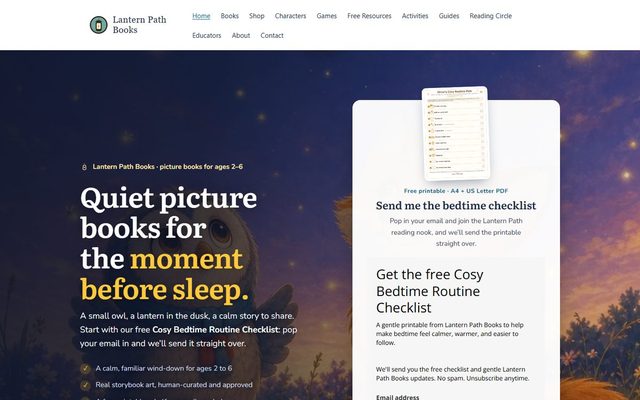 10,260 visitors / 30 dayslanternpathbooks.comChildren's publisher
 3,737 visitors / 30 dayswatchroute.comAgency site and 44 game arcade
 2,606 visitors / 30 daysausteraglobal.comExport company
 Charity rebuilddailybreadhouse.comBrisbane meal charity, rebuilt
 1,759 visitors / 30 dayslanternpathgames.comGames portal, new in October